DAPA®︎ 2.0Making Enterprise Data AI-ReadyFrom System of Record to System of Decision Intelligence
DreamArts’ Semantic DX: building the decision-intelligence foundation for large Japanese enterprises in the era of AI agents
Download PDF: [DAPA® 2.0 White Paper 1st_ed (PDF, 7.6 MB)]
Executive Summary
The decisive input of the AI era is not the model. It is data an AI can actually use — safely, in context, and with permissions intact. DAPA®︎ 2.0 calls this AI-ready data, and the conviction behind it is straightforward: the organizations that steadily cultivate such data, rather than those that merely adopt the newest model, will hold the lasting advantage.
Most enterprise systems are Systems of Record. CRM holds the state of an account; ERP holds the state of the ledger. They capture outcomes, not the reasoning that produced them — why a discount was approved, which precedent was consulted, under what exception. That reasoning, the decision trace, has tended to live in chat, email, meetings, and people’s heads, and has rarely become a durable system asset.
SmartDB® sits in a different place, and this is the structural premise of DAPA®︎ 2.0. For two decades it has stood on the execution path — the route along which proposals, approvals, returns for revision, and document circulation actually move through a large Japanese enterprise. Because each judgment is recorded as it is made, together with the people, permissions, documents, and rationale involved, SmartDB® accumulates decision traces and a Context Graph in the ordinary course of work. Data of this kind cannot be bought, nor can it be back-filled after the fact; it can only be cultivated over time, within the flow of work.
This is also where DreamArts’ particular vantage point matters. The reasoning above rests on field knowledge, layered permissions, and the human judgment on which large Japanese enterprises depend — concerns that sit at the center of how DreamArts has built a trusted operational foundation, not at its margins.
Why this approach matters especially in Japan. Publicly available estimates place Japan’s large enterprises at roughly 4,000 firms, employing around 15 million people[1], and project a growing shortage of IT talent — on the order of 450,000 people by 2030[2]. Most of the country’s IT professionals, moreover, sit on the vendor side rather than within user companies — the reverse of the pattern in the United States[3]. Under this structural constraint, making data AI-ready by deploying engineers to organize it from the top down is difficult to scale, and the data itself cannot simply be purchased. The route that does scale is generation within everyday work, by the business users who already run the process, on a no-code platform they can shape themselves. Seen this way, the constraint that might look like a limitation is precisely what makes the cultivation of AI-ready data — field-led, no-code, and in the flow of work — both practical and valuable. DAPA®︎ 2.0 is the strategy for making that route practical and scalable.
On this footing, SmartDB® evolves from a System of Record toward a System of Decision Intelligence (SoDI). The same data, now carrying meaning, context, rationale, and permission, allows AI to support human judgment with accurate context rather than surface-level matches. The principle is unchanged: the human remains in the loop and holds final responsibility, while AI extends and supports judgment rather than replacing it.
The strategic logic is straightforward. DreamArts already serves a substantial base of large Japanese enterprises — the foundation on which this data is generated — and its publicly disclosed mid-term plan sets out an ambition to reach more than a 10% share of the segment of organizations with 1,000 or more employees by FY2028[4]. The shift DAPA®︎ 2.0 describes, toward AI-ready data generation, is not a new market to be opened from zero, but the natural next layer atop an existing foundation, where the value of the data deepens the longer the platform is used. In this sense, every year of SmartDB® use adds to the advantage an organization accumulates for the era of AI agents. That is the next layer of durable advantage.
1.Enterprise and employee figures: Statistics Bureau of Japan, 2024 Economic Census for Business Frame (enterprises with 1,000 or more employees; figures aggregated across the relevant size bands).
2.IT-talent shortfall (~450,000 by 2030): METI-commissioned study, Mizuho Information & Research Institute, Survey on IT Human Resources Supply and Demand (2019), mid-range scenario; see also METI, DX Report.
3.Distribution of IT professionals (Japan vs. United States): IPA (Information-technology Promotion Agency), DX White Paper 2023 (section on the distribution of IT professionals by company type).
4.Market-share ambition: DreamArts, Mid-Term Management Plan 2026–2028 (disclosed 14 August 2025) — targeting a share above 10% among organizations with 1,000 or more employees by the end of FY2028.
Introduction — The protagonist of the AI era is not AI, but AI-ready data
The conversation around AI runs hot. On one side is the expectation that agents will soon carry out work autonomously; on the other, the quieter reality of teams that deployed AI and found it unusable. What separates the two is seldom the model. Given the same model, outcomes diverge on the quality of the operational data the AI is given.
DreamArts builds for that reality, and DAPA®︎ 2.0 is where the conviction takes shape. The aim is not the AI cycle itself, but the durable foundation that lets an organization keep drawing value from AI regardless of the cycle. At its center is what DAPA®︎ 2.0 calls Semantic DX, and its output is AI-ready data.
DAPA®︎ 2.0 follows DAPA® — DreamArts Practical AI®︎ — introduced in 2025. DAPA’s thesis was a practical, in-the-flow answer to inflated expectations of autonomous agents. Its first concrete implementation was released in April 2026 as SmartDB’s Practical AI option, and is already in use. The two are complementary across different time horizons: the first makes AI useful in the work of today, while DAPA®︎ 2.0 raises the quality of the operational data that future AI will depend on. Such data cannot be cultivated overnight, which is precisely why DAPA®︎ 2.0 begins now. Its first steps are concrete and near: vectorization in autumn 2026, and semantic technology — ontology and Context Graph — in spring 2027.
Chapter I — The Next Wall in AI Adoption: Meaning and Context
Many organizations are spending their time comparing the performance of AI models. The real difference, however, appears not in the relative merits of one model over another, but in the quality of the operational data an organization can hand to the AI. Given the same model, this is where outcomes diverge. This chapter examines that dividing line — what is missing when AI proves unusable in practice.
The pattern is familiar across large enterprises: AI is introduced, yet it goes unused on the ground, or the answers it returns cannot be applied to real work. The causes fall, broadly, into three.
Three patterns of “AI that doesn’t work”
- Answers without meaning. Keyword matching returns a surface-level response, but the operational context — the “why” behind it — is absent. A system can locate a specific ringi approval request — a consensus-based approval document common in Japanese enterprises — yet it cannot show which process that approval moved through, or who judged what along the way.
- Broken context. Context that spans departments, processes, and systems is not connected. Related information may exist, but the AI cannot determine how it applies to the situation at hand.
- The wall of organizational vocabulary. Terms particular to an organization’s work — ringi approvals, informal pre-approvals, approval routes, and document circulation — carry meanings that a general-purpose AI does not hold. They are treated as ordinary words, or passed over entirely.
“Having data” is not “understanding meaning”
Through years of digital transformation, many enterprises have accumulated a great deal of data. But having data and understanding what it means are fundamentally different things. The figures, text, and files stored in a database carry no meaning on their own. Whose decision produced this, and of what kind? What process did it pass through? What else is it related to? Who is permitted to see it? Only when this context is present does data begin to carry meaning.
Earlier waves of digital transformation advanced digitization, visibility, accumulation, and integration. The next stage concerns what the data means. This is the territory of Semantic DX, and its output is what DAPA®︎ 2.0 calls AI-ready data.
Semantic DX: a definition and four elements
DAPA®︎ 2.0 defines Semantic DX as the work of connecting the context, rationale, relationships, permissions, and organizational structure that lie behind data — and, in doing so, materially increasing the value of that data. It becomes real only when four elements are present together.
- Operational meaning (ontology). What a ringi approval is; what kind of concept an approval route represents — an organization’s own vocabulary, and the relationships among its concepts, structured and defined.
- Context and relationships (Context Graph). How each piece of data connects to others, and in what circumstances it was used — its context, history, and rationale, held as a graph.
- Semantic processing of unstructured information (vectorization). The large body of unstructured material — meeting minutes, comments, and email messages — converted into a numerical form in which an AI can work by closeness of meaning.
- Usable permissions (permission control). Who may reference what, and in which context — governed at the level of meaning. This is the safeguard that keeps an AI from handing the wrong information to the wrong person.
These four elements work as one. How they are realized in practice — and why each is indispensable to the others — is the subject of the chapters that follow.
Chapter II — The Japanese Context: From Structural Constraint to Durable Advantage
The argument of DAPA®︎ 2.0 is not that Japanese enterprises are unusual for its own sake. It is that the specific conditions of large Japanese organizations make the cultivation of AI-ready data both necessary and structurally durable when it is embedded in the flow of work. Those conditions are best understood through three lenses: a structural constraint in how the country’s IT talent is distributed, the scale of the market that constraint shapes, and the way advantage compounds once such data begins to accumulate.
A constraint that shapes the opportunity
Across most large economies, the people who build and operate software sit largely inside the companies that use it. In Japan the pattern is reversed. According to publicly available estimates, the majority of the country’s IT professionals — on the order of seven in ten — work on the vendor side rather than within user enterprises, roughly the inverse of the United States. The same body of analysis projects a shortfall of around 450,000 IT professionals by 2030.
For a generation, this arrangement worked well enough: large enterprises commissioned systems from vendors and integrators. But it leaves user organizations without the in-house engineering capacity to lead their own transformation, and it makes the data inside those organizations difficult to reshape on demand. As the surface area that must be digitized expands — and as AI raises the premium on well-structured operational data — the constraint becomes more visible, not less.
Why top-down data engineering does not scale here
This is the point at which DAPA®︎ 2.0 departs from the conventional answer. The familiar prescription for “AI readiness” is to assemble a central team of data engineers and organize the enterprise’s data from the top down. In an economy where most engineering talent sits outside the user company, that approach is difficult to staff and slow to complete — and the data it would organize cannot, in any case, be purchased ready-made.
The route that does scale runs the other way. The people who understand an organization’s work most precisely are the people who perform it. On a no-code platform they can shape themselves, these business users — citizen developers — build and refine the applications, forms, and workflows through which work actually moves. In doing so, they generate AI-ready data as a by-product of ordinary operation, without waiting for a central team to finish organizing the enterprise. This is the practical meaning of what DreamArts calls the democratization of digital: field-led, in the flow of work, and continuous. The constraint that might look like a limitation is precisely what gives this model its value.
The scale of the opportunity
The market this constraint defines is substantial. Publicly available estimates place Japan’s large enterprises at roughly 4,000 organizations, employing around 15 million people. DreamArts already serves a meaningful base of these organizations, and its publicly disclosed mid-term plan sets out an ambition to reach more than a 10% share of the segment of organizations with 1,000 or more employees by FY2028.
What matters for DAPA®︎ 2.0 is less the headline figure than the surface on which it rests. The shift toward AI-ready data generation does not require opening a new market from zero. It is the natural next layer atop an installed base already running its core operations on SmartDB® — where the operational data, the permission model, and the organization’s own vocabulary are already in place, and where the move into Semantic DX is an extension of existing use rather than a fresh procurement.
Two advantages already established, and a third now within reach
For two decades, DreamArts has built around two durable advantages. The first is the operational data itself: the real processes and decisions of large enterprises, accumulated through years of use and not reproducible overnight. The second is the user-master and permission model — the layered structure of a single organization’s hierarchy, together with the group companies, affiliates, and external partners who take part in its work. This is a complexity that a repurposed HR directory cannot address, and one that SmartDB® has refined over twenty years.
A third advantage now follows from these two: the capacity to generate AI-ready data continuously and safely. Because the data and the permission model are already in place, this advantage is available to SmartDB® in a way it is not available to a general-purpose tool adding “AI readiness” after the fact. And it compounds. The longer SmartDB® is used, the deeper the Context Graph grows, and the more difficult the resulting operational context becomes to reproduce. Each year of use, then, adds to the advantage an organization carries into the era of AI agents — an advantage that strengthens with time rather than eroding.
This advantage cannot be bought, and it cannot be quickly rebuilt. An organization’s operational meaning, its permission structure, and its accumulated decision context can in principle be reconstructed on another platform — but doing so, and maintaining it as the business changes, is a large and continuous undertaking rather than a one-time import. It also depends on labor that is in short supply: the systems integrators who would carry it out are themselves understaffed, and the specialized understanding it requires — of ontology, and of an enterprise’s own permission logic — is rarer still. The same structural shortage that makes top-down data engineering impractical in Japan makes after-the-fact reconstruction difficult to sustain at scale as well. What protects the advantage is not secrecy or any single feature, but the years of accumulation behind it and the scarcity of the effort its reproduction would demand.
Throughout, the principle of DAPA®︎ 2.0 is unchanged. The aim is not to remove people from the work, but to let the field knowledge they already hold become an organizational asset — with the human in the loop, and final judgment in human hands.
Chapter III — AI-Ready Data: What It Is, and How It Is Cultivated
However capable a model becomes, it can work only with the data it is given. The question that decides the outcome is therefore not the sophistication of the AI but the state of the operational data beneath it — whether that data is fit to be used. DAPA®︎ 2.0 gives this state a name: AI-ready data. It is the central concept of this paper, and it is worth defining with care.
AI-ready data is not simply data that has been digitized or structured. It is operational data prepared so that AI — and, in time, AI agents — can use it safely and in practice: data that carries its meaning, its place in the work, its relationships, its permissions, and the rationale behind it. Structured records alone do not meet this bar; a database full of clean fields can still be mute.
The six conditions of AI-ready data
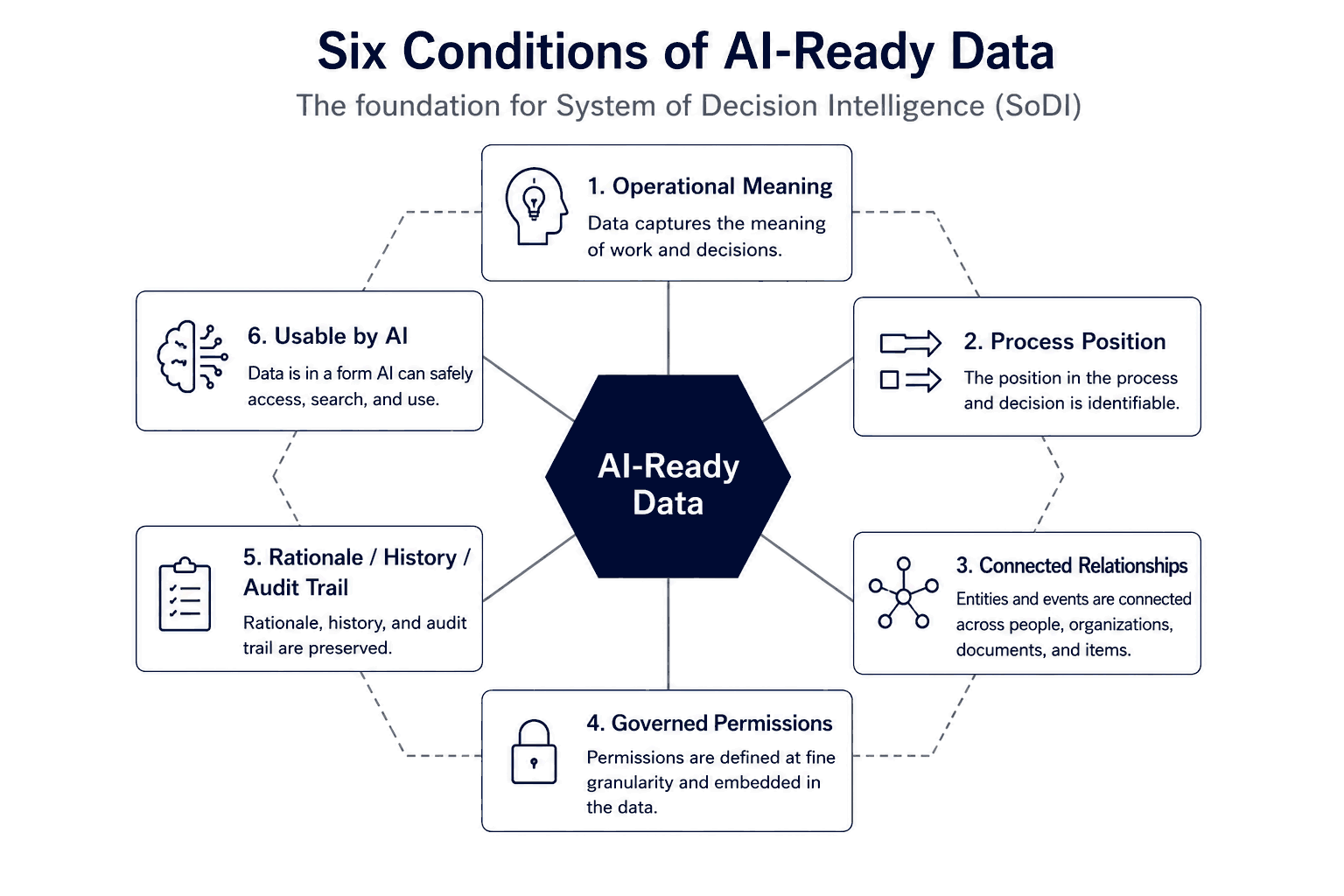
DAPA®︎ 2.0 describes AI-ready data through six conditions. Data is ready for AI to the degree that it satisfies all six together.
- Its operational meaning is defined. The organization’s own vocabulary and concepts — what a ringi approval is, what an approval route or a case status represents — are structured and defined, not left implicit.
- Its place in the process is identifiable. It is clear which flow, which step, and which stage produced the data.
- It is connected to related people, organizations, documents, and history. The data is not an isolated record but is linked, graph-fashion, to the applications, approvals, participants, and documents around it.
- Its permissions are governed. Who may reference or use which data, and in what context, is managed as one with the business process — not added afterward.
- Its rationale, history, and audit trail can be traced. Why a decision was made, and how it changed over time, can be followed.
- It is usable by AI for search, summary, inference, and suggestion. It is held in a form, granularity, and quality that vectorization, retrieval-augmented generation, and agents can process safely.
Taken together, these conditions describe data that an AI can not only retrieve, but interpret and use responsibly — the difference between a system that returns matches and one that supports judgment.
Generated through use, cultivated through improvement
A defining property of AI-ready data is that it is not assembled in a one-off project. When work is carried out on SmartDB, AI-ready data arises in the ordinary course of operation: the fields, masters, workflows, permissions, comments, and attached documents that running the business already requires. But it does not stop there. Those same elements mature — through daily use, and through the steady improvement made by the people closest to the work. AI-ready data is, in this sense, both generated by use and cultivated by the field, and DAPA®︎ 2.0 treats that dual character as essential rather than incidental.
This is also why the work cannot be rushed. AI-ready data does not become high-quality simply because it accumulates. It calls for continuing care: standardizing input fields, maintaining and updating master data, managing the validity periods of rules and documents, reviewing permission settings, and auditing how AI is used against the data. What distinguishes SmartDB® is that these disciplines are not a separate governance program bolted onto the platform; they are carried out as one with the business process itself. Because they can be designed and refined continuously by the field in a no-code environment, the cost of sustaining governance falls — and the same platform that generates AI-ready data also becomes the foundation on which it is governed.
Throughout, the human remains in the loop. The purpose of cultivating AI-ready data is to let people judge with better context and greater confidence, not to remove their judgment from the work. How the underlying technologies make all six conditions hold together is the subject of the next chapter.
Chapter IV — The “Two New + One Proven” Stack Behind Semantic DX
Semantic DX may sound conceptual, but it is not merely a philosophy; it rests on concrete technology. What makes it work as a real system is a particular combination — two technologies newly brought in, and one that SmartDB® has developed over twenty years. DAPA®︎ 2.0 refers to this as the “Two New + One Proven” composition. When all three are present, SmartDB® becomes a practical foundation on which Semantic DX can actually be implemented inside a large Japanese enterprise.
The premise: SmartDB® stands on the execution path
Before the technologies themselves, one structural premise deserves stating plainly: where SmartDB® sits among an enterprise’s systems.
Most enterprise systems are built to record results — Systems of Record. They capture an outcome, or a current state, but the path of judgment that led there tends not to survive. That a discount was approved is recorded; why it was approved, which precedent was consulted, and under what exception are not. Such decision traces have historically scattered across chat, email, meetings, and individual memory — valuable knowledge that rarely became a system asset.
SmartDB® stands in a different place. Because proposals, approvals, returns for revision, and document circulation all proceed on the platform, the inputs to a judgment — the documents, the participants, timestamps, amounts, quantities, and other relevant facts, and the rationale held in comments, attachments, and linked records — accumulate together with the progress of the work. They are not tallied after the fact; they are recorded, in structured form, at the moment the judgment is made. A data warehouse receives data only afterward, when the context of the decision has often been lost; CRM and ERP preserve current state but not the route to it. Standing on the execution path itself, SmartDB® can retain the background, course, and grounds of a judgment as one with the operational data.
These accumulated decision traces — stitched across people, organizations, counterparties, cases, contracts, documents, and approval histories, and across time — form the structure this paper calls the Context Graph. It is not designed in the abstract after the fact; it grows from the daily activity of running work, approving, commenting, and linking related records on SmartDB. An execution path that can hold, accurately, whose judgment was made in which context is not built overnight; the depth of the Context Graph rests on two decades of accumulation.[5]
To stand on the execution path is necessary, but not on its own sufficient: other workflow products sit there too. What sets SmartDB® apart is that its execution path is fused, by default, with the organizational and permission structure of a large Japanese enterprise. On SmartDB, every record is created already bound to who — in which position, across the hierarchy of a single company and the group companies, affiliates, and partners around it — may see or act on it, because permission control is a standard property of the platform, connected to every form, workflow, and field, at the scale required by Japan’s largest enterprises. General-purpose or globally designed workflow products reach this complexity, when they reach it at all, through integration work layered on after the fact; lighter no-code tools typically do not offer permission control at this granularity. Their execution-path data, in consequence, does not become AI-ready on its own. On SmartDB® it does — meaning, context, rationale, and permissions accruing together, in the ordinary course of work.
5. The salience of Context Graphs, execution paths, and decision traces in the age of AI agents is a theme gaining ground in enterprise AI internationally. In “AI’s trillion-dollar opportunity: Context graphs” (Foundation Capital, December 2025), Jaya Gupta and Ashu Garg argue that enterprise value is shifting from systems that record what happened toward systems that capture why decisions were made, and introduce the concepts of decision traces and the context graph. DAPA®︎ 2.0 proceeds in parallel with that discussion, while grounding it in the operational reality of the large Japanese enterprises DreamArts has long served — and in SmartDB’s two-decade position on the execution path. foundationcapital.com/ideas/context-graphs-ais-trillion-dollar-opportunity
Two new technologies, and one proven one
Semantic technology — giving data meaning and context. Semantic technology is the broad name for the methods that attach meaning to data and connect data to one another by context. It rests on two parts. The first is ontology, the skeleton of meaning: an explicit, human-defined dictionary and blueprint of how concepts relate, so that a ringi is understood as a kind of application process, and an approver as a role carrying defined authority. The second is the Context Graph, the nervous system of context: where ontology defines the type of a business concept, the Context Graph expresses how actual data, people, organizations, history, and documents have in fact connected — growing from daily work along the structure the ontology lays down.
Vectorization — letting AI work by closeness of meaning. Vectorization converts words and documents into multidimensional numerical arrays in which terms close in meaning come to sit close together. Terms such as ringi approval, approval request, and internal application take on neighboring values, so that an AI can locate information near in meaning even when the wording differs. This is the technology beneath large language models, retrieval-augmented generation, and semantic search — the sense organ through which AI can take in the large body of unstructured material that work produces.
Permission control — the proven technology of trust. If semantic technology and vectorization supply the capacity to handle meaning and context, permission control is what allows that capacity to be used safely, and in a way the organization can trust. Without it, an AI handling operational data introduces the risk of leakage, misuse, and wrong answers reaching the wrong people. SmartDB’s permission control is not an access setting added after the fact; who may reference or operate on what, and in which process context, is managed as one with form design, workflow, and the user master. It is the layer in which DreamArts has, over twenty years, expressed in software the trust that large Japanese organizations maintain across their hierarchies and partners — and the means by which that trust can extend, more widely and more safely, into the era of AI agents.
Why all three are needed
The six conditions of AI-ready data are met fully only when these three technologies act together. Remove semantic technology, and data carries neither meaning nor context; an AI cannot even grasp what a ringi is. Remove vectorization, and unstructured material such as minutes and comments cannot be handled by meaning, so search and summary lose their accuracy. Remove permission control, and even where meaning and context are present, what may be shown to whom is undefined, and the result cannot be used in practice. The three are not interchangeable; only together do they complete AI-ready data — which is why DAPA®︎ 2.0 treats the “Two New + One Proven” set as a single whole.
| Technology | Conditions of AI-ready data it satisfies |
|---|---|
| Semantic technology — ontology + Context Graph | operational meaning is defined · place in the process is identifiable · connected to related people, organizations, documents, and history · rationale, history, and audit trail can be traced |
| Vectorization | usable by AI for search, summary, inference, and suggestion |
| Permission control (the “+1”) | usable permissions are governed |
Semantic technology forms the core, answering four of the six conditions; vectorization and permission control each complete one.
Chapter V — From System of Record to System of Decision Intelligence
For twenty years, SmartDB® has served as a System of Record — recording, storing, and retrieving operational data accurately. With Semantic DX, it begins to do something more: to hold not only the data but its meaning, context, rationale, and permissions. The shift is from recording to supporting judgment, and it is the essential change that carries SmartDB® beyond a System of Record.
From “recording” to “supporting judgment”
The destination of that shift is a System of Decision Intelligence (SoDI): a platform that supports and raises the quality of the decisions an organization makes. The AI-ready data accumulated in SmartDB® becomes the basis on which AI can offer context-grounded support at every level — the judgment of the individual, the decision of the department, the strategic choice of the executive. What was the basis for the board’s decision on a similar matter three years ago? How does the risk on this project compare with past cases? When an AI can answer questions like these in a way that holds up in practice, that is what SoDI means.
The point is worth stating sharply. The question is not what we ask AI to answer. It is what grounds the answer.
The principle remains unchanged
SoDI does not replace human decision-making. By organizing and presenting the rationale of past decisions, the related information, the risks, the permissions, and the state of the process, it lets people decide faster and with greater confidence. DreamArts has held to the principle of human–AI collaboration — the human in the loop — from DAPA® onward: final responsibility and judgment rest with people, and AI is there to support and extend that judgment, not to supplant it. DAPA®︎ 2.0 carries the same principle forward without exception.
What Semantic DX changes, layer by layer
The benefit of Semantic DX reaches every level of an organization.
- For frontline staff, support shifts from search to context: judgment is informed by the surrounding history and rationale, and access to knowledge that once lived with particular individuals is opened up.
- For department managers, the tacit knowledge otherwise lost to retirement and rotation is preserved — a veteran’s judgment, and the context around it, accumulates as part of the Context Graph rather than leaving with the person.
- For executives, AI adoption can scale without weakening governance, because permission control is built into how AI reaches data in the first place.
- For IT and AI enablement teams, the spread of “shadow AI” can be contained: permissions, usage logs, and cost stay under control even as AI use expands across the company.
- For compliance, risk, and audit functions, decision history, audit trails, and permission logs are consolidated, and the work of compliance checking and internal audit becomes markedly more efficient.
Across all of them, the pattern is the same: the same operational data, now carrying meaning, context, rationale, and permissions, comes to serve judgment rather than merely record it.
Chapter VI — The Business Context Server: Opening AI-Ready Data to Agents, Safely
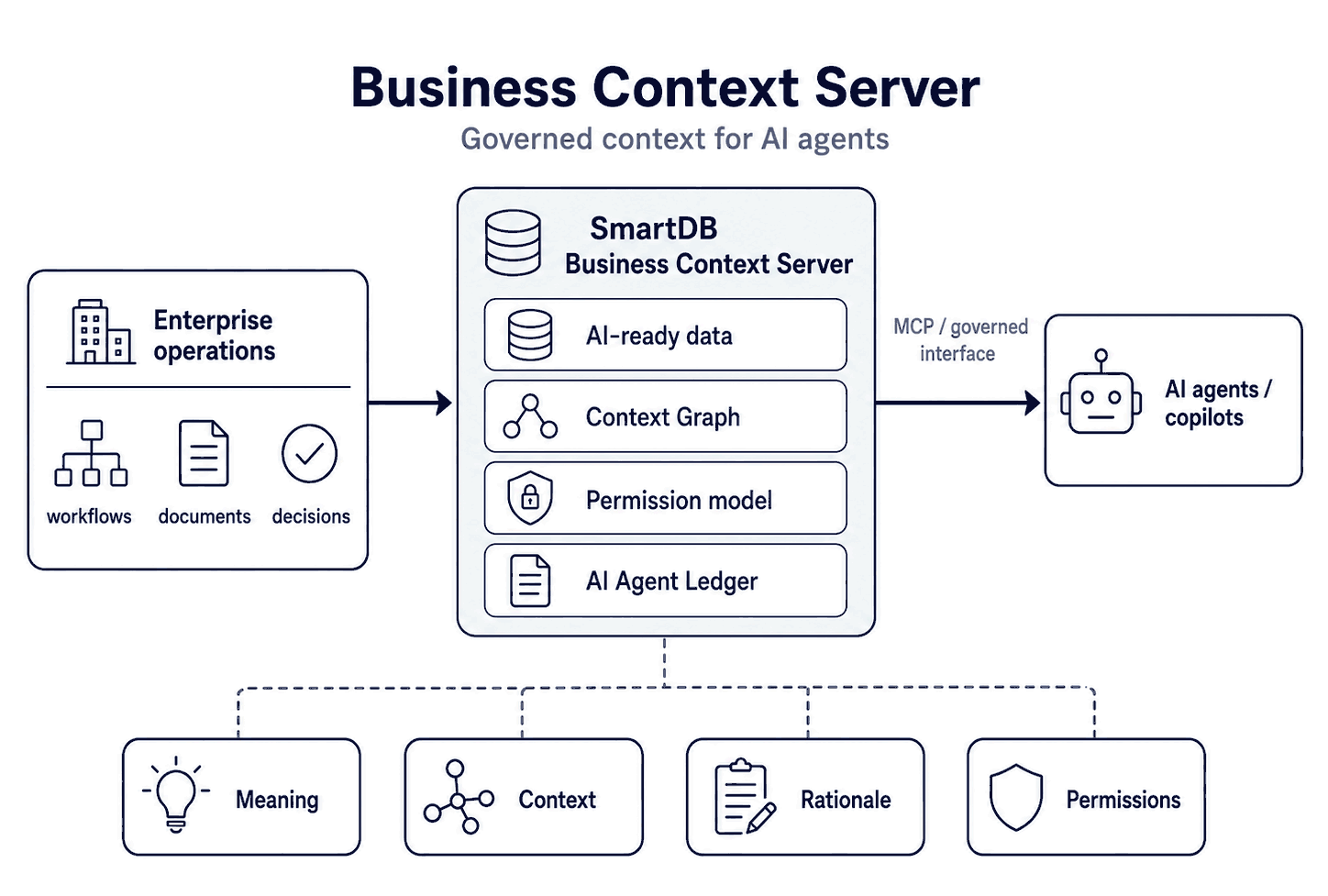
The chapters before this one described an asset: AI-ready data, cultivated on the execution path, carrying its meaning, relationships, rationale, and permissions. An asset, however, is only as valuable as the access it allows. As AI moves from assistant to agent — from answering when asked to acting on its own initiative — the question shifts from whether the data exists to how it is delivered to the systems that will use it, and how an organization keeps control while it does. DAPA®︎ 2.0 answers with a single structural idea: SmartDB® becomes a Business Context Server — the governed doorway through which AI and agents reach the organization’s context.
From foundation to access
Having AI-ready data is necessary; it is not sufficient. For the data to be useful, the AI that consumes it must be able to reach it — and today that reach is built one tool at a time. Each new assistant, copilot, or agent is wired to each data source through its own bespoke integration, and every such connection is a place where permissions can be dropped, context stripped, and governance quietly eroded. The arrangement does not scale: as the number of AI tools and the number of data sources both grow, the integrations between them grow as their product — an M×N tangle that no organization can maintain safely. What is missing is not more integrations but a common, governed interface — one doorway, through which context passes with its meaning and its permissions intact.
MCP and the Business Context Server
That doorway is taking shape as an industry standard. The Model Context Protocol (MCP) is an open standard for connecting AI systems to the data and tools they need: rather than building a bespoke integration for every pairing, a source exposes its context once, through a common interface, and any compliant AI can reach it — turning that M×N tangle into a far simpler M+N[6]. Two properties make it a foundation worth building on. It is model-agnostic, so the work of exposing an organization’s context is not bound to any one model and is not wasted when models change; and it is governed as a neutral, open project rather than any single vendor’s, so building on it is not a bet on one provider. Its premise aligns exactly with the thesis of this paper — that the durable foundation, not the model of the moment, is where lasting value sits.
Within DAPA®︎ 2.0, SmartDB® takes the role of an MCP server, and DreamArts calls it the Business Context Server. What it serves is not raw data but AI-ready data: the meaning defined by the ontology, the relationships held in the Context Graph, the rationale recorded along the execution path, and — inseparably — the permissions that govern who may see what. Where an ordinary connector hands an AI a table of rows, the Business Context Server hands it context that already carries the question of who is allowed to use it.
6. The Model Context Protocol (MCP) is an open standard introduced by Anthropic in November 2024 for connecting AI systems to external data sources and tools through a common interface. In December 2025, Anthropic donated MCP to the Agentic AI Foundation, a directed fund under the Linux Foundation co-founded by Anthropic, Block, and OpenAI, with support from Google, Microsoft, AWS, Cloudflare, and Bloomberg.
Why a context server, not merely a data source
This distinction is the whole point. The third technology of Chapter IV — permission control, the “+1” — does not stay behind when data passes through the interface; it travels with the data. A request reaching SmartDB® through the Business Context Server is resolved against the same permission model that governs the platform for people: the user master, the layered hierarchy, the group companies and external partners, and the process context in which a given record may or may not be referenced. An agent acting on behalf of a user sees what that user is permitted to see, and no more. Permission control governed at the level of meaning, rather than bolted on as an access filter, is what allows operational data to be opened to autonomous systems without being opened to misuse. It is the difference between a data source an organization must trust is queried safely, and a context server that enforces safety by construction.
The AI Agent Ledger
Opening context to agents creates a new thing to govern: the agents themselves. When software begins to act — to read, summarize, decide, and initiate on its own — an organization needs to know which agents exist, on whose authority each operates, what data each may reach, and what each has actually done. DAPA®︎ 2.0 calls the answer the AI Agent Ledger: a register that treats agents as accountable actors within the same permission and audit model as the people who have always been there. An agent is, in this sense, a new kind of user — and like any user, it must be known to the system before it can be trusted by it. Without such a ledger, the “shadow AI” of the previous chapter returns in a more consequential form: not employees quietly pasting data into a chatbot, but unregistered agents acting on operational systems with no record of their authority or their actions. With it, the disciplines SmartDB® has long applied to human access — identity, permission, logging, audit — extend to non-human actors, and the spread of agents becomes something an organization can see and govern rather than merely absorb.
The principle holds at agent scale
None of this displaces the principle the paper has held from the start. The Business Context Server and the AI Agent Ledger are precisely the mechanisms by which the human in the loop survives contact with autonomous systems: permissions decide what an agent may reach, the ledger records what it did, and final responsibility stays with the people on whose authority it acts. DAPA’s commitment — that AI extends human judgment rather than replacing it — does not weaken as agents grow more capable; it is the reason the architecture is built this way. The more an organization delegates to agents, the more it needs the governed interface and the ledger that keep delegation accountable.
Seen together, the Business Context Server and the AI Agent Ledger are how the asset of the preceding chapters becomes usable in the era of agents without the organization surrendering control of it. The foundation cultivated over twenty years pays off here, at the point of access — because the context is exposed through one standard doorway, and because everything that passes through it, human or agent, does so under permission and on the record.
Chapter VII — Use Cases: Where Semantic DX Meets the Work
What the scenarios below have in common is that none of them is a story about deploying some special AI. In each, the operational data accumulated through the continued use of SmartDB® is what gives the AI its meaning. Each is set out as the situation before, what SmartDB® changes, and the effect that follows; and in each, consistent with the principle of DAPA®︎ 2.0, the final judgment remains with a person.
Scenario A — Semantic search across decisions
To learn how the board had judged a similar matter three years earlier once meant searching old ringi documents by hand and assembling the related information piece by piece. Because ringi, approval histories, attached documents, and comments are linked within the Context Graph, an AI can instead search by meaning across a question such as “board-approved matters involving Client A within the past three years,” and present what it finds together with the rationale behind each. Hours of investigation become minutes, and the quality and speed of the decision improve because the support is grounded in evidence.
It is worth noting what the AI is searching. The Context Graph it draws on was not designed, company-wide, in advance. It arose as departments ran their ringi, left their comments, and linked their related records, day after day — the meaning structure emerging through use. Semantic DX develops in exactly this way.
Technologies: semantic technology (Context Graph) · vectorization · permission control.
Scenario B — Succession of knowledge
When a veteran of twenty years retires, the context can leave with them: why a particular client requires particular terms, why a process was designed the way it was. Where that person’s workflow actions, comments, and decision history have accumulated in the Context Graph during their tenure, an AI can continue to draw on that context after their departure, answering a successor’s questions from it. Person-dependent knowledge becomes an organizational asset, and “no one knows but them” ceases to hold.
Technologies: semantic technology (ontology + Context Graph) · vectorization.
Scenario C — A check for approvers
A busy approver cannot always compare a matter against similar past cases, or test it fully against the rules. As an approval step is reached, an AI can automatically surface the differences from comparable cases, the points of concern under internal rules, and the reasons similar matters were sent back for revision in the past — for the approver to review before reaching their own judgment. Approval grows more accurate, fewer matters are returned for revision, and the burden of judgment eases, with the decision still made by a person.
Technologies: semantic technology · vectorization · human in the loop.
Scenario D — An agent that prepares the approval request
Preparing an approval request has meant working by hand from past examples, and knowing who to turn to next has depended on experience. Drawing on SmartDB’s operational context, an AI agent can propose the content of a comparable request, the attachments it will need, a recommended approval route, and the next action to take — leaving the final content and the decision to act with the person. Preparation time falls, omissions grow rarer, and a new or newly rotated employee comes up to speed faster.
Technologies: Context Graph · business context server · AI Agent Ledger · human in the loop.
Chapter VIII — The Third Corner: The Outcome of a Twenty-Year Strategy
For the twenty years since SmartDB® was first conceived, DreamArts has returned to a single question: where is the corner? The image is drawn from Reversi — widely known as Othello — in which a corner, once taken, cannot be reversed, gives the player a durable position, and grows stronger as the game goes on. Two corners have been the object of that long pursuit.
The two corners already taken
The first corner is data. However useful a system’s features, a system that does not hold an organization’s important operational data carries little switching cost and offers thin value. SmartDB® set out to be the system in which that data lives.
The second corner is the user master and permission model. A large Japanese enterprise is not a single hierarchy but a hierarchy entwined with group companies, affiliates, and the external partners who take part in its work. A repurposed HR directory cannot express this complexity; SmartDB’s user master was built to. Over twenty years, it has become the place where the permission structure of the enterprise is maintained.
Together, these two corners made SmartDB® more than a tool for building applications. They made it the core platform on which a large enterprise’s important operational data and permission model accumulate — the advantage beneath long-term use, departmental rollout, and company-wide adoption.
The third corner now within reach
With the arrival of the AI-agent era, the chance to take a third corner has opened: the foundation that generates AI-ready data. By running work on SmartDB® and using it day to day, an organization continuously produces the meaning-bearing, permission-aware data that AI and AI agents can use safely. It is a corner that becomes available only because the first two are already in place: without the data, and without the permission model, AI-ready data cannot be generated continuously and safely at all. This is the conviction at the center of DAPA®︎ 2.0.
And of the three, this corner is the one that compounds most plainly. The longer SmartDB® is used, the more the AI-ready data accumulates and deepens, and the greater the thickness of operational context that becomes increasingly difficult for another system to reproduce. The advantage is difficult to imitate, and it strengthens with time rather than fading. In this sense, using SmartDB® today means accumulating the advantage an organization will carry into the era of AI agents.
Closing
A final note on perspective. The word “AI,” in time, will wear thin as a buzzword. But what wears thin is the word, not the substance of the technology beneath it. What DreamArts keeps in view is not the passing AI boom, but the durable foundation that lets an organization go on drawing value, in the field, from AI and digital technologies — the deeper technological shift these represent — whatever the cycle happens to be doing.
Semantic DX — the conviction at the heart of DAPA®︎ 2.0 — is the technical philosophy DreamArts will continue to develop and refine through that era. It is also how DreamArts gives concrete form, in the new context of the AI age, to its mission: to contribute to the development of people, organizations, and society, filled with the joy of co-creation. Through this work, DreamArts intends to provide the practical foundation on which large Japanese enterprises can navigate the AI era.
And this is not, in the end, a matter of one company’s product strategy. To cultivate operational data — carrying meaning, context, and permission — out of the daily work of the field, rather than through top-down, large-scale data programs, is a way of building competitiveness from the depth of the field itself. It is a path particular to Japanese enterprises, and a viable one.
Semantic DX is the very ground on which large Japanese enterprises will compete on the global stage in the AI era.
Appendix
The two press releases below are reproduced as English transcreations of DreamArts’ original Japanese releases. Each is faithful to the scope of its original publication date; the concepts and terminology introduced in this DAPA®︎ 2.0 white paper have not been retrofitted into them.
Appendix A
Press Release — The DAPA® Announcement (June 2025)
Originally published June 26, 2025 (Tokyo). English transcreation.
DreamArts Unveils “DAPA®︎” (DreamArts Practical AI®︎): A New Approach to AI for Large Enterprises
Originally published June 26, 2025 (Tokyo). English transcreation.
A practical, hands-on approach that embeds AI into the business process itself — and a deliberately measured stance on the hype around autonomous AI agents
DreamArts Corporation (Headquarters: Shibuya, Tokyo, and Hiroshima; President & CEO: Takaaki Yamamoto), a provider of cloud services for large enterprises, today announced DAPA® (DreamArts Practical AI) — a new, proprietary approach to applying AI in large Japanese enterprises.
DAPA® is not a single product feature. It is an overarching design-and-implementation philosophy spanning DreamArts’ products — SmartDB®, Shoprun®, and InsuiteX® — together with the consulting, adoption, and project-support services around them. More than a product concept, it sets out a new way of thinking about enterprise AI that connects directly to the reform of business processes.
Put AI where the work happens — a measured view of the hype around AI agents
As expectations for AI-agent technology have risen, DreamArts has taken a deliberately clear-eyed view of its limits, approaching AI from a calm and realistic standpoint. In the day-to-day reality of large enterprises, what matters is not fully autonomous decision-making by AI, but a design built around collaboration between people and AI (keeping humans in the loop).
In complex, judgment-heavy domains rich in tacit knowledge — internal approval workflows (known in Japan as ringi), cross-project coordination, and organization-wide consensus-building — deploying a fully autonomous AI agent does not, in practice, earn trust or work reliably from day one.
What DAPA® is: implementation principles for delivering results in real operations
DAPA® (DreamArts Practical AI®︎) is a practical, implementation-oriented approach to AI. It draws a clear line between what to automate and what to support, and aims to make the most of where AI genuinely excels. While it naturally includes automating work, its central focus is AI as support for the work — going beyond automation alone. It is built around the following principles:
- Embedding AI into the business-process engine
- Real-time integration with business databases
- Turning prompts into a managed, shared database, continuously cultivated by “citizen developersa[7]
- A choice of multiple AI engines, with flexible switching between them
7.“Citizen developers” are employees in business departments — not IT staff or specialist engineers — who build and improve applications themselves. Encouraging these non-specialists to adopt and cultivate AI on their own is central to the DAPA® concept.
Across the whole business process: accelerating decisions and organizational performance
DAPA® delivers effects that go beyond efficiency gains in individual tasks, extending across the entire organization:
- Accelerating “in-house DX” — a pressing management priority for every large enterprise
- Complementing and extending the know-how of experienced staff, through AI support in both routine and non-routine work that demands deep expertise
- Speeding up cross-departmental coordination and decision-making
- Removing bottlenecks in an organization’s capacity to act and its execution speed
- Creating an environment in which citizen developers — non-IT professionals — can advance their own work independently
In this way, AI helps address challenges particular to large enterprises: amplifying organizational knowledge, increasing the speed of action, and boosting strategic decision-making.
From the “democratization of AI” to the “democratization of digital”
Through SmartDB® and Shoprun®, DreamArts has long supported in-house innovation driven by citizen developers. DAPA® is a natural extension of this, accelerating the “democratization of digital”[8] through the democratization of AI.
Today, as the first step under DAPA®, DreamArts also issued a related release on the implementation of AI features in SmartDB®: “DreamArts Implements AI in SmartDB® — The First Step of DAPA: Fusing AI into Business Processes to Raise Organization-Wide Performance.” (pr250626-2)
8.The “democratization of digital” means enabling business (non-IT) departments to use digital tools themselves and thereby accelerate digitalization across the whole company.
Comment from Japan Airlines
Keisuke Suzuki, Executive Officer and Head of the Digital Technology Division, Japan Airlines Co., Ltd.; President, JAL Digital Co., Ltd.:
“What I find especially compelling about DAPA® is that, by embedding AI into the business process itself, it can empower the entire organization. Alongside generative AI such as ChatGPT and Copilot, which support individuals, DAPA-based products and services that drive organization-wide transformation will broaden the scope of AI even further. The DAPA® concept — in which AI naturally enters the flow of diverse work, so that anyone on the front line can receive its support without even being conscious of it — is, to me, a powerful way to advance front-line-driven digital transformation. I have high expectations for it.”
For investors and shareholders
DAPA® is not merely a product concept; it is central to the growth strategy across DreamArts’ entire SaaS business. Strengthening the AI capabilities of SmartDB® deepens engagement with existing large-enterprise customers and creates upsell opportunities, while serving as a differentiator in winning new customers. By expanding high-value-added services tied to adoption and usage support, DreamArts aims to grow ARR (annual recurring revenue) and maximize LTV (customer lifetime value). We are confident that the distinctiveness of DAPA®-based practical AI-adoption support will further strengthen the company’s presence in the SaaS market and contribute to medium- and long-term corporate value.
Guided by its philosophy of co-creation, DreamArts will continue to provide total solutions that strengthen frontline capabilities and enterprise competitiveness.
About SmartDB®
SmartDB® is the No. 1 business-digitalization cloud in Japan’s large-enterprise market.[9] It enables no-code development of everything from individual frontline tasks to company-wide, cross-functional processes. Centered on workflow and a web database, it offers a broad range of capabilities, flexible integration with external systems, fine-grained permission management, and support for demanding security requirements. It is used by major organizations across virtually every industry, including MUFG Bank, KDDI, Tsuruha HD, Tsukuba University. SmartDB® runs on Microsoft Azure, scaling flexibly as usage and content grow.
9.Source: Techno Systems Research, “2025 Survey of Vendor Share in the SaaS Workflow Market.”
About DreamArts Corporation
DreamArts Corporation, whose corporate mission is “to contribute to the development of people, organizations, and society filled with the joy of co-creation,” embodies co-creation itself, serving as a true solutions partner in helping customers solve their challenges comprehensively. Its principal cloud services include SmartDB®, the business-digitalization cloud for large enterprises; Shoprun®, which supports multi-store operations reform; and InsuiteX®, a business cockpit that transforms the way large enterprises work.
Media contact: DreamArts Corporation, Public Relations (Kanai / Oka). Ebisu Garden Place Tower 29F, 4-20-3 Ebisu,
Shibuya-ku, Tokyo 150-6029. Tel: +81-3-5475-2501 / +81-90-9149-3958. Email: pr@dreamarts.co.jpCompany, product, and service names are registered trademarks or trademarks of their respective owners. © DreamArts Corporation
Appendix B
Press Release — SmartDB® Practical AI (PA) Option (April 2026)
Originally published April 9, 2026 (Tokyo). English transcreation.
SmartDB® Practical AI (PA) Option Now Available
Weaving AI into business processes to accelerate decision-making across the organization
DreamArts Corporation (Headquarters: Shibuya, Tokyo, and Hiroshima; President & CEO: Takaaki Yamamoto), a provider of cloud services for large enterprises, today announced the release of “SmartDB® Practical AI (PA),” a new option for SmartDB®, its business-digitalization cloud for large enterprises, available from April 9, 2026. By weaving AI into the business process itself, the PA option removes the barriers to AI adoption in large enterprises and accelerates decision-making across the organization. New capabilities will roll out in two phases — in April 2026 and over the course of 2026.
Practical AI — a hands-on approach to AI that transforms business processes
DreamArts is advancing its technology under DAPA® (DreamArts Practical AI®),[10] a practical, real-world philosophy for applying AI’s strengths in organizing information and supporting judgment directly within business processes. The PA option, released today, weaves AI naturally into business processes, creating an environment in which AI is used not only by individuals but by the organization as a whole. SmartDB® has long supported large enterprises on two fronts: frontline-driven business digitalization, and the construction of advanced business systems by IT specialists. The PA option deepens these strengths further, improving both the accuracy and the speed of organizational decision-making. By strengthening the governance of AI use, it also contributes to stronger organizational security.
10.
Key features of the SmartDB® Practical AI (PA) option
Built on the business-digitalization foundation — processes and database — that DreamArts has provided to many enterprises, the PA option embeds AI on the “inside” of work rather than the “outside.” Its four main features are as follows.
- AI embedded in the business-process engine. Many companies’ business processes are already defined and running in SmartDB®. The PA option embeds AI directly into this “work as it actually runs,” so that AI performs checks and judgments within the flow of the process and becomes integral to decision-making. The tasks AI does well — checking, assisting, and suggesting — blend naturally into each step of the workflow, improving the accuracy and speed of decisions across the organization.
— Figure: AI woven into the decision-making process —
- Continuous improvement and stronger governance through a prompt database. The PA option manages prompts centrally as a database, letting “prompt designers” continuously refine them through dialogue with AI. By having prompt designers prepare and manage high-quality prompts suited to the work, the whole organization can use AI to a consistent, high standard, rather than relying on individually written prompts of varying quality. The scope and tasks for which AI is used can be clearly managed, building a safe, well-governed operating foundation. This removes problems caused by personal dependency and skill gaps, so users obtain stable results without having to be conscious of the AI itself.
— Figure: Prompt database —
- A business foundation that becomes “AI-ready” naturally through digitalization. When work is digitalized in SmartDB®, data is naturally structured and accumulated in a form AI can readily use. Because SmartDB® can digitalize even the complex operations particular to large Japanese enterprises with no code, it steadily brings every kind of work toward an “AI-ready” state. On this foundation, AI blends naturally into business processes and can be used in ways that fit real operations.
- AI use built on permission control. Because SmartDB® holds its database and permission management as one, AI can be applied to work under appropriate access control, with the security and governance of business data as a precondition.
A use case, and the people involved
The PA option delivers significant value in the everyday work of internal approval (known in Japan as ringi). The following is an example of the value it offers each person involved in a ringi. (Some of the functions below are scheduled for release within 2026.)
- The applicant (originator). Attachments submitted with a request are automatically converted to text by AI OCR, and AI auto-fills document fields based on their content. Required items and supplementary information are suggested according to business rules, and anything needing correction is highlighted — greatly improving both the speed and the accuracy of preparing documents.
— Figure: A ringi at the drafting stage —
- The approver. AI assistance reduces the burden of review and shortens approval times. On re-submission, suggestions of what changed, highlighting of points to check, and check-points informed by past ringi improve both the quality and the efficiency of review.
- The prompt designer. The prompts that drive the AI can be created simply by typing text, and are continuously refined through AI-assisted generation and validation in a playground using real data.
— Figure: Continuously refining prompts in the AI prompt database —
- The system administrator. AI usage and the consumption of points (tokens) are made visible, enabling cost optimization and governance that helps prevent excessive or improper use.
— Figure: Billing management and usage monitoring —
Beyond these, the benefits of AI can extend to any work digitalized in SmartDB® — company-wide contract management and seal-application (approval) requests, accounting payment requests, HR onboarding and offboarding requests, new-product development requests in service divisions, incident-response reports in IT departments, and more.
Launch of “PA Certification” to raise frontline employees’ AI skills
In addition to its existing SmartDB® certification program (SmartDB® Certified Specialist, or SCS),[11] DreamArts will introduce a new certification grade, “PA Certification,” which verifies appropriate knowledge and understanding of AI. It opens in May 2026, with early examinations and preparatory courses held at the same time, and an official launch planned for July 2026. Certification grades will be released in stages, in step with the expansion of the PA option’s features. (The “PA Certification” exam requires the entry-level “BRONZE” certification.)
— Figure: Overview of the SmartDB® certification program —
Pre-registration for the early “PA Certification” exam and the introductory course: https://hibiki.dreamarts.co.jp/smartdb/s-radio-menou-precede/
11.SmartDB® certification program (SmartDB® Certified Specialist): https://hibiki.dreamarts.co.jp/smartdb/scs/
Comments from early-adopter customers
Shunnosuke Hayashi, Digital Platform Strategy Division, THK Co., Ltd.:
“We are evaluating the PA option as an early-adopter customer. Having driven both the migration to SmartDB® and its company-wide use, we had been considering how to make use of form data scattered across the company. With the PA option, that form data can be structured and registered and managed as documents — which we expect will not only improve searchability and enable further use of data for users, but also allow that structured data to be put to further use with AI. We see the PA option as an important solution that uses AI to further elevate our use of SmartDB®, which we have expanded as a company-wide business foundation.”
Ryutaro Miyake, Executive Officer in charge of Group Finance & Accounting and Head of the Finance & Accounting Division, Tsuruha Holdings Inc.:
“We use SmartDB® mainly in our finance departments, and we are evaluating the PA option for uses such as contract work and supplier management. In applying AI, we believe the role of the person who makes the final decision is important. The PA option lets us manage the know-how of people with business expertise as a prompt database and, in addition, draw on the structured information fields that SmartDB® holds — which we believe will greatly broaden the value that AI can create.”
Pricing, availability, and development roadmap
Use of the PA option requires a SmartDB® subscription. A freemium plan is also offered to existing SmartDB® customers; please contact DreamArts for details. The first phase, in April 2026, provides practical AI-support features such as input assistance and checking; the second phase, planned for later in 2026, will expand to more advanced decision support that draws on the data and permission information accumulated within SmartDB®. The prompt database will also be updated in stages, with the capabilities as a whole evolving continuously.
PA option details: https://hibiki.dreamarts.co.jp/smartdb/function/ai/